
Iris, in development
The clinical assistant at the centre of SeamLess — booking, summarising, digitising, and sitting beside the doctor rather than in front of them.
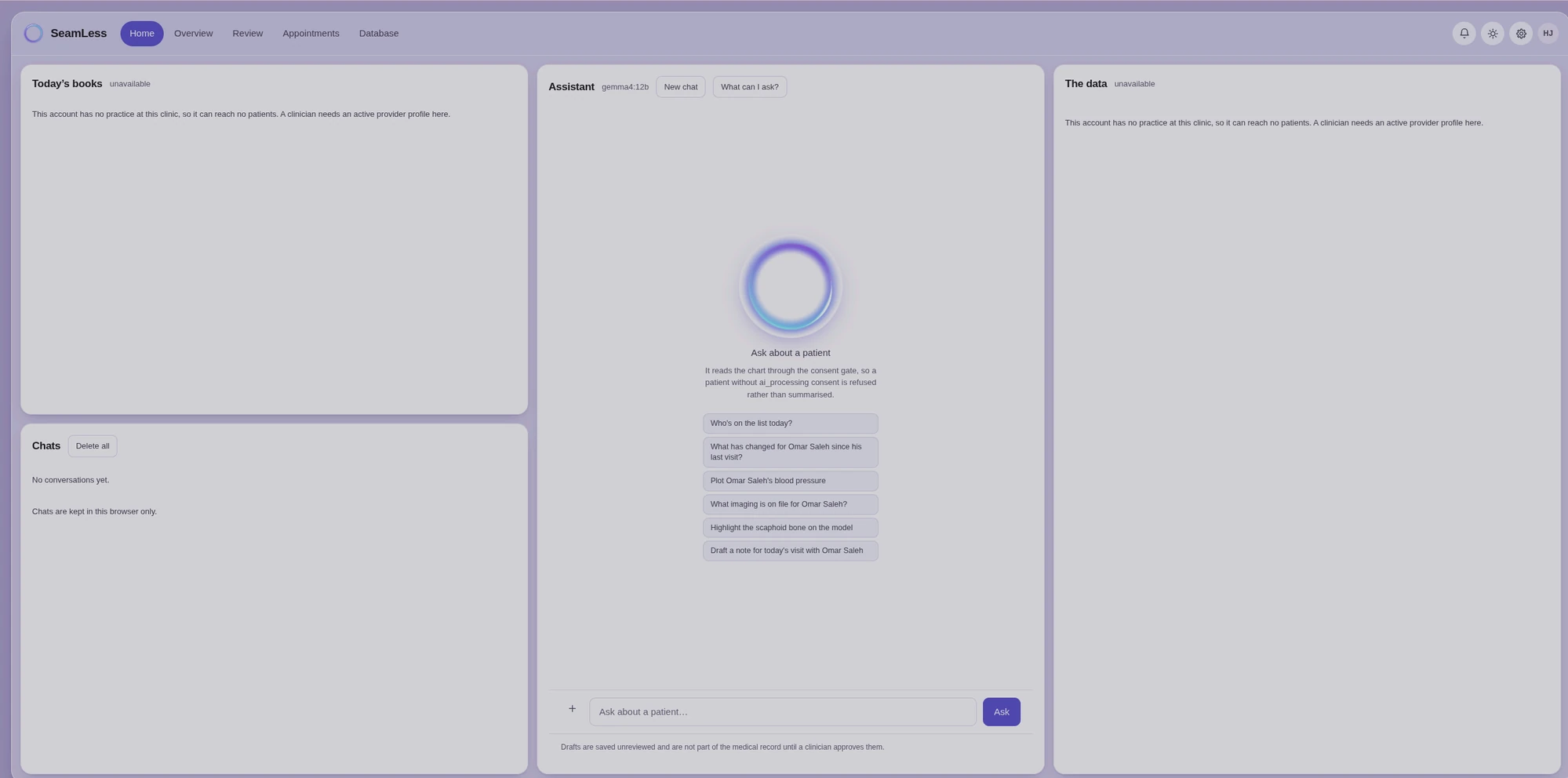
Black Automation is building a clinical assistant. It is called Iris, it is under active development, and it is the intelligent layer of SeamLess — the clinic management platform we have been designing around a problem that is easy to state and hard to fix: most clinics do not have one system. They have six.
A small clinic today runs on some combination of paper, a scheduling book, a messaging app, a spreadsheet, and whatever software arrived with the last piece of equipment. None of them know about each other. Patient information ends up distributed across all of them, appointments take manual coordination to move, and a doctor who wants the history of the person sitting in front of them goes looking for it — through a folder, a chat thread, and someone else's memory.
Iris exists because that search is the part of the day that should not need a person.
What it does first
Four capabilities are being built before anything else, chosen because each one removes a task that a person is currently doing by hand every day.
Booking
Iris reads a patient's request in ordinary language — "I need to see the doctor tomorrow afternoon" — checks it against the schedule, offers the hours that are actually free, and writes the appointment when one is chosen.
The scheduling layer stays structured underneath: date, hour, doctor, patient, as four separate fields rather than one line of text. That is what lets the clinic answer its own questions without asking an assistant anything — who is in this afternoon, which hours are still open, how often this patient comes in. A booking system that stores "Tuesday-ish with Dr. Amin" can answer none of them.
Summarising reports
Given a patient's authorised history, Iris produces a structured overview a doctor can read before a consultation instead of during it: what has been treated, what was investigated, what changed since the last visit.
It is an information-assistance mechanism and the platform labels it as one. A summary is not a diagnosis, it does not replace reading the record, and it is never presented as authoritative. That distinction is written into the product rather than into a disclaimer at the bottom of a page.
Digitising data
Clinical documentation arrives in whatever form the world hands it over: a photograph of a referral letter, a scanned result, a form filled in by hand. Iris turns those into structured records attached to the patient, the visit and the investigation they belong to — rather than to whichever message thread they happened to be sent in.

This is the least glamorous of the four and probably the most valuable. A clinic's history is only useful if it can be found, and most of it is currently unsearchable by anything except a person who remembers where it went.
Assisting the doctor
The rest of the day: following up with a patient after a visit, answering the routine messages that do not need clinical judgement, organising notes into the record, and preparing the reports a clinic has to produce anyway.
Iris does not run the clinic
The architectural decision underneath all four is the one worth stating plainly, because it is what makes the rest defensible.
The database is the source of structured truth and the application controls the workflow. Iris consumes information it has been authorised to see, and returns something useful.
It does not hold the schedule. It does not decide who may see a record. It is not the system of record and it cannot become one by accident. Every action it takes runs through the same permissions as a person doing the same thing, which means the clinic can audit what happened without auditing a model.
The alternative — letting a model act as database, scheduler and business logic at once — demos beautifully and fails in exactly the places a clinic cannot afford failure. We would rather ship the boring architecture.
What is not built yet
Iris is not finished and it is not in a clinic. Neither is the compliance work around it. The technical report is explicit about what remains: the healthcare-data regulations for each market we would deploy in, a formal data-retention policy, audit logging of significant access and modification, disaster-recovery specifications, and the governance rules for what the AI layer may access and when a human has to approve.
- Which data Iris may read, per role, written down rather than assumed.
- Which actions it may take without a person confirming them.
- How anything it generates is labelled as generated.
- How its errors are detected, and by whom.
None of that is a footnote. A clinical assistant that cannot answer those questions is a prototype, and calling it anything else would be the first thing a hospital procurement review caught.
Where to read more
The full technical report on the platform — architecture, data model, the clinic hierarchy, infrastructure, security, the commercial model and the open engineering questions — is published in the SeamLess report. When Iris is ready to be tried rather than read about, it will appear on the bench with the rest of what we build.